
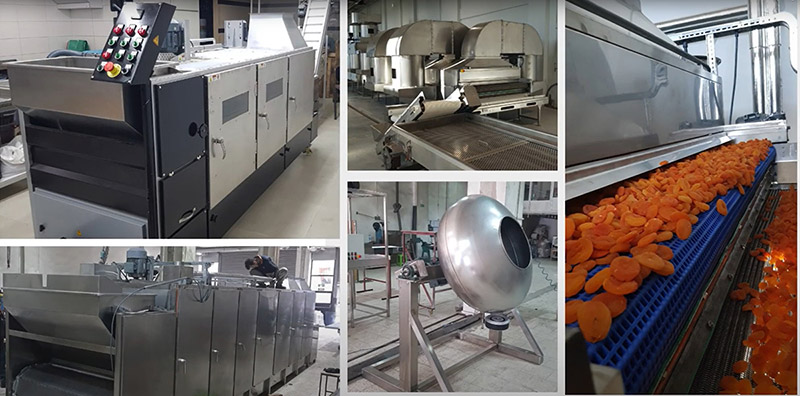
Nut roasting ovens are industrial equipment used to enhance the flavor of nuts, reduce moisture content, and extend shelf life. These machines play a critical role in production processes and come in different models with various operating principles. This guide explores the working principles of nut roasting ovens, factors affecting quality, how to choose the most suitable oven model, and energy efficiency considerations.
1. What is a Nut Roasting Oven and How Does It Work?
Nut roasting ovens operate by roasting nuts under controlled high temperatures, reducing their moisture content and enhancing their natural flavors. Their operation depends on essential components such as heating elements, airflow mechanisms, and temperature control systems.
1.1. Key Components and Operating Principles of a Roasting Oven
- Main components:
- Heating system: Electric resistances, gas burners, or hybrid systems.
- Airflow mechanism: Ensures uniform roasting by circulating hot air.
- Drum or tray system: Moves products to ensure even roasting.
- Temperature and time control: Adjustable for optimal roasting results.
Nuts are placed in the oven at a predetermined temperature, and hot air circulation ensures even roasting. This process varies depending on the type of nut and roasting time.
1.2. Heat Control Systems and Airflow Management
- Convection ovens: Continuously circulate hot air for uniform roasting.
- Infrared ovens: Apply direct heat to the surface of the product for fast, energy-efficient processing.
- Drum ovens: Ensure even roasting by continuously moving the nuts.
1.3. Differences Between Manual and Automatic Ovens
- Manual ovens: Require constant operator supervision and are suitable for small-scale production.
- Automatic ovens: Manage temperature, time, and airflow automatically, minimizing errors and reducing labor costs.
2. Factors That Determine Quality in Nut Roasting
The proper management of the roasting process directly affects the taste, texture, and shelf life of nuts. The most critical factors influencing quality include:
2.1. Ideal Temperature Settings for Even Roasting
- Hazelnuts, almonds, walnuts: 130-150°C
- Sunflower seeds, pumpkin seeds: 160-180°C
- Chickpeas, peanuts: 120-140°C
Temperature control is essential to prevent burning and ensure uniform roasting.
2.2. Roasting Time and Variations Based on Product Type
- Shell nuts (hazelnuts, walnuts): Require longer roasting at lower temperatures (20-30 minutes).
- Small-sized nuts (sunflower seeds, chickpeas): Require shorter roasting at higher temperatures (10-15 minutes).
2.3. Moisture Control and Its Impact on Shelf Life
- High moisture content causes staleness and mold formation.
- Lowering moisture to 2-3% after roasting significantly extends shelf life.
3. Choosing the Right Roasting Oven for Each Type of Nut
Selecting the right oven model according to the type of nut is crucial for production efficiency and product quality.
3.1. Best Oven Models for Hazelnuts, Peanuts, Almonds, Chickpeas, Sunflower Seeds, and Walnuts
- Hazelnuts , Peanuts and Almonds: Drum or convection ovens are recommended.
- Chickpeas: Require specialized chickpea roasting ovens due to longer roasting times.
- Sunflower seeds & pumpkin seeds: Infrared or drum ovens are ideal for quick, high-temperature roasting.
3.2. Best Solutions for Small-Scale Businesses
- Electric convection ovens
- Small-capacity drum ovens
3.3. Best Options for High-Capacity Production Facilities
- Gas or hybrid drum ovens
- Fully automatic conveyor roasting systems
4. Energy Efficiency and Cost Optimization
To minimize energy costs and ensure eco-friendly production, certain strategies should be applied.
4.1. Differences Between Gas, Electric, and Hybrid Ovens
| Oven Type | Advantages | Disadvantages |
|---|---|---|
| Electric | Eco-friendly, low maintenance cost | High energy consumption |
| Gas | Low operational cost, fast heating | Requires gas connection |
| Hybrid (Gas + Electric) | Energy-efficient, offers flexibility | High initial investment |
4.2. Energy Savings with Heat Recovery Systems
- Reusing waste heat can reduce energy consumption by up to 30%.
- Improving oven insulation minimizes heat loss.
4.3. Impact of Automation on Labor Costs
- Fully automatic ovens can reduce labor costs by up to 40%.
- Minimize product defects and waste.
5. Key Considerations When Choosing the Right Nut Roasting Oven
When selecting a roasting oven, consider production capacity, energy consumption, and long-term operational benefits.
5.1. Choosing an Oven Based on Production Capacity
- Small-scale production: Electric or infrared ovens.
- Large production facilities: Gas-powered drum or convection ovens for optimal efficiency.
5.2. Maintenance and Spare Part Availability
- Choose models with readily available spare parts.
- Low-maintenance ovens provide long-term cost benefits.
5.3. Long-Term Durability and Return on Investment
- Energy-efficient ovens lower operational costs, providing long-term profitability.
- Stainless steel bodies and durable construction extend lifespan.
By following this guide, you can select the most suitable nut roasting oven for your business and establish an efficient production process!